Concept art of the SPARC digital twin. (Image: CFS)
Commonwealth Fusion Systems, a fusion firm headquartered in Devens, Mass., is collaborating with California-based computing infrastructure company NVIDIA and Germany-based technology conglomerate Siemens to develop a digital twin of its SPARC fusion machine. The cooperative work among the companies will focus on applying artificial intelligence and data- and project-management tools as the SPARC digital twin is developed.
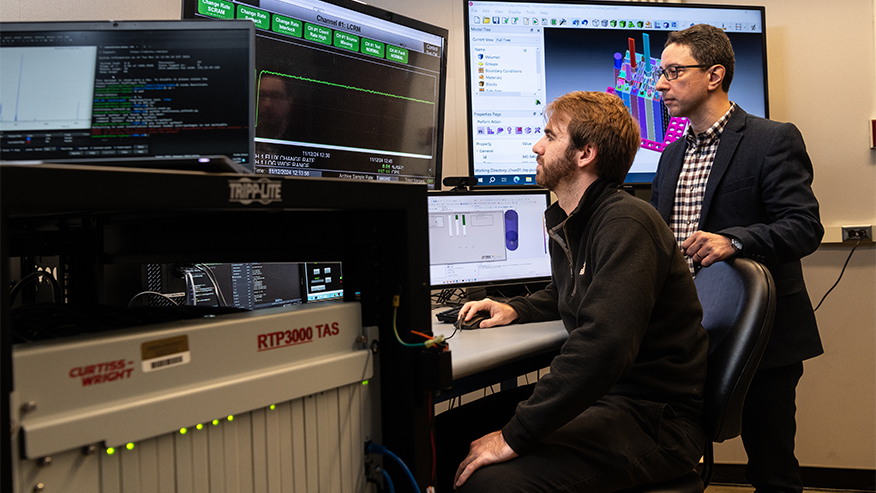
A digital twin of Purdue’s reactor appears on monitors in Stylianos Chatzidakis’s lab. Chatzidakis observes PhD student Zach Dahm, seated, as he toggles through different views. (Purdue University photo/John Underwood)
A research reactor built in 1962 that was converted to digital control and operation in 2019 is aiding the development of advanced nuclear reactors, such as small modular reactors and microreactors. An article published by Purdue University describes how Purdue University Reactor Number One (PUR-1), currently the only facility to be licensed for a fully digital safety and control system by the Nuclear Regulatory Commission, is being used to perform “first-of-a-kind experiments that are unique to the nuclear sector.”
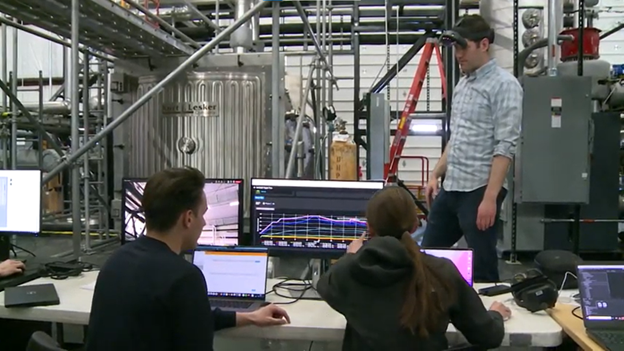
A screenshot taken from a INL video demonstrating MAGNET and its digital twin. (Source: INL)
Researchers at Idaho National Laboratory (INL) recently performed their first digital twin test of the Microreactor Agile Non-nuclear Experimental Testbed (MAGNET) and captured the demonstration in a video posted July 14. The digital twin—a virtual representation of a microreactor—was built using advancements in remote monitoring, autonomous control, and predictive capabilities that could help lower operating costs of microreactor technologies and enhance their safety.